Wednesday, January 23, 2019

Prime Number Problem with Rot13 answer

There are 2 prime numbers between 100 and 199 such that the tens digit is a prime number, the ones digit is a prime number, and the tens and ones digit taken together are a 2 digit prime number. Find the sum of these 2 prime numbers.

Answer:

The numbers in question obviously start with "1", these are all the prime numbers between 100 and 199:

122
123*
125
127

132
133
135
137*

152
153*
155
157

172
173*
175
177.

There are more, but one or more of their digits are not prime.

Go to Rot13.com, paste the following coded message in the box, and it will instantly decipher.


Erzbir gur cevzrf jubfr graf naq barf qvtvgf ner abg cevzr:

Guvf yrnirf bar-gjragl-frira, bar-guvegl-frira, bar-svsgl-frira naq bar-friragl-guerr.

Erzbir gur cevzrf jubfr graf naq barf qvtvgf gnxra gbtrgure ner abg cevzr:

Guvf yrnirf bayl bar-guvegl-frira naq bar friragl guerr. (Gur bgure gjb-qvtvg ahzoref ner qvivfvoyr ol guerr, 57 = 3 k 19)

Nqq gurz:

Bar-guvegl-frira cyhf bar friragl guerr rdhnyf guerr uhaqerq gra.
Qb lbh frr jung “Gur Fbyire” vf qbvat? Jvgubhg hfvat n yvfg, ur dhvpxyl aneebjrq vg qbja gb 4 pubvprf, gjb bs juvpu jr pna rnfvyl ryvzvangr nf gur fhz bs gurve qvtvgf vf qvivfvoyr ol 3, urapr gubfr ahzoref ner abg cevzr.

Tuesday, January 22, 2019

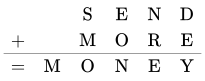
SEND MORE MONEY PROBLEM

Solving cryptarithms[edit]

Solving a cryptarithm by hand usually involves a mix of deductions and exhaustive tests of possibilities. For instance the following sequence of deductions solves the example SEND+MORE = MONEY puzzle above (columns are numbered from right to left):
  1. From column 5, M = 1 since it is the only carry-over possible from the sum of two single digit numbers in column 4.
  2. Since there is a carry in column 5, O must be less than or equal to M (from column 4). But O cannot be equal to M, so O is less than M. Therefore O = 0.
  3. Since O is 1 less than M, S is either 8 or 9 depending on whether there is a carry in column 4. But if there were a carry in column 4, N would be less than or equal to O (from column 3). This is impossible since O = 0. Therefore there is no carry in column 3 and S = 9.
  4. If there were no carry in column 3 then E = N, which is impossible. Therefore there is a carry and N = E + 1.
  5. If there were no carry in column 2, then ( N + R ) mod 10 = E, and N = E + 1, so ( E + 1 + R ) mod 10 = E which means ( 1 + R ) mod 10 = 0, so R = 9. But S = 9, so there must be a carry in column 2 so R = 8.
  6. To produce a carry in column 2, we must have D + E = 10 + Y.
  7. Y is at least 2 so D + E is at least 12.
  8. The only two pairs of available numbers that sum to at least 12 are (5,7) and (6,7) so either E = 7 or D = 7.
  9. Since N = E + 1, E can't be 7 because then N = 8 = R so D = 7.
  10. E can't be 6 because then N = 7 = D so E = 5 and N = 6.
  11. D + E = 12 so Y = 2.

You can see a YouTube with a different solution method CLICK HERE or tinyurl.com/y74lvtig

ANSWERS TO "PACKET" QUESTIONS -- PAGE 1

Answers to 2017 "Algebra" Problems -- page 1

Note: this is for a group of Students in Minneapolis MN preparing for the 6th grade math challenge. It is not for the general public.

Question #1. Maria and Juan collect coins -- you have the details.

J = 25:  M = 44-25 = 19

Mgold = 19 - 8 = 11  ;  Jgold = 15 - 11 = 4 (answer)

Question #6 Julio starts a savings account -- you have the details.

let M = months.

J = 100 + 50 M   Maria = 1000 + 25 M

100 + 50 M = 1000 +25M   subtract 25 M from both ises and subtract 100 from both sides:

25 M = 900 M = 36 (answer)  Check: 100 +50 times 36 = 1900 and 1000 + 25 times 36 = 1900

Question #4: Ivy thought of a number -- you have the details.

let x be the number:

(2x - 6) divided by 2 = x - 3 : (x  - 3) times 10 + 70 =  10x + 40

10x + 40  divided by 5 = 2x + 8 = 28 solve for x, x = 10 (Answer)

Check: various stages  10 20 14 7 70 + 70 = 140 28

Question # 7  Two acute angles of a triangle are in the ratio 3:2   What are the measures of the two angles.

This is a ratio and sum problem that a student named Kai Alton had a trick for.

Guess any two angles with the correct ratio: for example, 20 and 30. Add them up and get 50.

But we are supposed to get 90. 90 divided by 50 is 1.8.

Multiply each number by 1.8 and get 36 and 54 which are in the right ratio and add up to 90.

Note: 36 is 2 times 18 and 54 is 3 times 18. 36 degrees and 54 degrees (Answer).


Monday, January 21, 2019

CRYPTARITHMETIC PROBLEM THAT IS EASY TO SOLVE

DRAFT

Crypt Arithmetic Problems That Are Easy To Solve, Revised


The assignment may seem trivial but we just want to verify that you are reading this blog. Please post your answer as a comment.

2012 6th Grade Math Challenge Problem #1
162
+XD
-----
2D7
D must equal 5 so we have:
162
+X5
-----
257
When we add X to 6, we must get 5 and a carry of 1.
So, 6 + X = 15, or X = 9
162
+95
-----
257 

Check: Do the above with a calculator and verify that it is correct. 

2012 6th Grade Math Challenge Problem #5
ON + ON + ON + ON = GO
Adding ON 4 times is the same as multiplying by 4.
ON
x4
-----
GO
Try various values for N.
N can't be zero because then, N and O would be the same.
If N is 1, O = 4 and 4 x O would be 16, generating a carry and giving a three-digit answer.
If N is 2, O = 8 and 4 x O would be 32, again generating a 
carry and giving a three-digit answer.
If N is 3, 4 x 3 = 12. That makes O = 2 with a carry of 1.
G = 4 x 2 + 1, or 9.
This gives:
23
x4
----
92
Check: 23 + 23 + 23 + 23 = 92
Verify this with a calculator.

Saturday, January 19, 2019

About time arithmetic

TUESDAY, SEPTEMBER 24, 2013 


Repost January 19 2019
In the 5th and 6th grade math challenges, there are many problems about time.

This is was written on September 24, 2013 around the autumnal equinox.

The sun rose today at 7:02 AM and will set tonight at 7:06 PM..

It will rise tomorrow at 7:04 AM.

How long is the day September 24 and the night September 24-25?

Day and night should be approximately equal and approximately 12 hours each.

Answer below.

Yesterday, the sun rose at 7:02 AM and set at 7:06 PM. Today it rose at 7:04 AM. How long was the day on September 24 and how long was the night of September 24-25?

Note that the colon between hours and minutes is not a decimal point; time uses base 60. One each side of the colon, you can use decimal arithmetic. Working with time is a little tricky!

Day: use 24 hour clock, add 12 to PM hours. So, sun sets at 19:06. 19:06 - 7:02 = 12:04

Night: how much time between sunset and midnight? 12:00 - 7:06. You can't subtract :06 from :00, so "borrow" 60 minutes from the hour of midnight: 11:60 - 7:06 = 4:54. Now add the time until sunrise:
4:54 + 7:04 = 11:58.

The day is 12 hours and 4 minutes long and the night is 11 hours and 58 minutes long. These don't add up to 24 because we are looking at two different days. We are near the autumnal equinox so the day and night are approximately equal to 12 and approximately equal to each other.

As time goes on, days will get shorter and nights longer until the winter solstice, in December.

Today (this was September 24 2013) the sun rises at 7:04 AM and sets at 7:04 PM, so the day is exactly 12 hours.Tomorrow, the sun will rise at 7:05 AM, the night is longer than the day: prove this!

You will find the night is 11 hours and 61 minutes, so change 61 minutes to an hour and one minute

Wednesday, October 2, 2013

SOME CRYPT ARITHMETIC HINTS


SOME CRYPT ARITHMETIC HINTS

1)     READ THE PROBLEM! THEY MAY NOT BE ASKING FOR ALL THE LETTERS, OR ONLY SOME NUMBERS ARE ALLOWED.

2)     IN THIS SITUATION
 XXX
+XXX
----
NXXX N=1 (The number sticking out is 1)

3)If F + 1 generates a carry, F=9

4)EVERY LETTER STANDS FOR A DIFFERENT NUMBER, EVERY NUMBER IS A DIFFERENT LETTER. THIS CAN SOMETIMES REDUCE THE NUMBER OF GUESSES YOU NEED TO MAKE, BECAUSE SOME NUMBERS ARE ALREADY "USED."

5) SAME_NUMBER + SAME_NUMBER = 2 X SAME_NUMBER = EVEN_NUMBER. FOR EXAMPLE,9+9=18, YOU WRITE 8, AN EVEN NUMBER, AND CARRY 1.

6) JUMP TO THE LAST COLUMN, BECAUSE THERE ARE NO CARRIES TO WORRY ABOUT.

7) IF YOU GET TO A DEAD END,BACK UP!

Thursday, September 26, 2013

Sunrise, Sunset for September 26-27 2013


Facts: On September 26, 2013 the Sun rose at 7:05 AM and will set at 7:02 PM. On September 27, the Sun will rise at 7:07 AM.

Question: How long is the day on September 26 and how long is the night of September 26-27?

-----------------------------
Hints: for mathematical methods for time, see the posting with title Equinox. Once you have done the calculation, the results will make sense; the day will be 11 hours and 50-some minutes, the night will be 12 hours and some minutes. Just look closely at the sunrise and sunset times.

From now until the Winter Solstice on December 21 2013, the days will be getting shorter and the nights will be getting longer.

Wednesday, September 25, 2013

The Daily Jumble

The Daily Jumble appears every day in the Saint Paul Pioneer Press. You can also see it at this address:
Daily Jumble for September 24 2013 (Sorry, this does not work on Apple products, only on PCs)

I have found that some students really like this kind of problem.

Hints: #1 A group of boats.
#2 A deep narrow ravine, often seen in Western movies, a gang might hang out there.
#3 One of the most popular computer styles, it is two three-letter words stuck together.
#4 What happens to a concert when the band refuses to play (verb).

You will end up with these circled letters: FEEGCHAOPACN. You are trying to make a six-letter word, a two-letter word, and a four-letter word. There are very few two-letter words, one of these is OF, so cross out O and F.  Now look at the cartoon, the words on the cartoon, and the letters that are left and guess the cartoon caption.

The Daily Jumble is a good exercise in problem solving. I have worked out a bunch of tricks for solving them. The tricks involve permutations and logic, both math topics.

If anybody tries this, send me an email at margolis.stephen@yahoo.com and I will send you a bunch of tricks for solving this kind of problem. If you have an Apple computer and can't open the link, tell me your room and teacher and I will give you a paper copy.

EQUINOX PROBLEM SOLUTION

Yesterday, the sun rose at 7:02 AM and set at 7:06 PM. Today it rose at 7:04 AM. How long was the day on September 24 and how long was the night of September 24-25?

Note that the colon between hours and minutes is not a decimal point; time uses base 60. One each side of the colon, you can use decimal arithmetic. Working with time is a little tricky!

Day: use 24 hour clock, add 12 to PM hours. So, sun sets at 19:06. 19:06 - 7:02 = 12:04
Night: how much time between sunset and midnight? 12:00 - 7:06. You can't subtract :06 from :00, so "borrow" 60 minutes from the hour of midnight: 11:60 - 7:06 = 4:54. Now add the time until sunrise:
4:54 + 7:04 = 11:58.

The day is 12 hours and 4 minutes long and the night is 11 hours and 58 minutes long. These don't add up to 24 because we are looking at two different days. We are near the autumnal equinox so the day and night are approximately equal to 12 and approximately equal to each other.

As time goes on, days will get shorter and nights longer until the winter solstice, in December.

Today, the sun rises at 7:04 AM and sets at 7:04 PM, so the day is exactly 12 hours.Tomorrow, the sun will rise at 7:05 AM, the night is longer than the day: prove this!

You will find the night is 11 hours and 61 minutes, so change 61 minutes to an hour and one minute.

Tuesday, September 24, 2013

In the 5th grade math challenge, there are many problems about time.

This is written on September 24, 2013 around the autumnal equinox.

The sun rose today at 7:02 AM and will set tonight at 7:06 PM..

It will rise tomorrow and 7:04 AM.

How long is the day September 24 and the night September 24-25?

Day and night should be approximately equal and approximately 12 hours each.

Answer tomorrow.


Wednesday, December 26, 2012

KEPLER'S LAWS

Kepler's laws are very important

Here is a link to a 5-minute movie about them:LINK TO KEPLER MOVIE

Here is a written summary:

German astronomer Johannes Kepler was born in December 1571, and throughout his 59 years of life, he contributed immensely to science. He is most well-known, however, for his three laws of planetary motion. This work stemmed from a collaboration with Danish astronomer Tycho Brahe. Kepler mathematically analyzed some 20 years of precise planetary observations that Brahe collected. He determined how the solar system’s planets move the way they do and laid the foundation for Isaac Newton’s theory of gravity. What we now call his three laws are theories that are universal, verifiable, and precise — and they don’t just govern the motion of the planets, but also comets, asteroids, and other minor bodies orbiting the Sun.

Kepler’s first law says that the orbit of every planet is an ellipse, with the Sun at one of two focus points. A circle is a special type of ellipse that has just one focus, which is located at its center. All other ellipses look like flattened circles, and have two focus points. If you take any point on the ellipse, the sum of the distances to the focus points is constant. 

Before Kepler’s work, astronomers tried to describe the motion of the planets via interconnected circles, but they struggled to match observations. They also could not predict where planets would appear in the sky. Kepler’s theory changed that and showed how elegantly the planets moved.

Kepler’s second law says that a line joining a planet and the Sun sweeps out equal areas during equal intervals of time. Thus, a planet moves fastest when it’s closest to the Sun (at a point called perihelion) and slowest at its farthest point from the Sun (known as aphelion). You can see this property best with objects that have longer elliptical orbits, like comets. As they near the Sun, they travel much faster than when they are more distant. 

Nine years after Kepler published his first two laws, he determined the last one. Kepler’s third law says that the square of the orbital period of a planet is directly proportional to the cube of the semi-major axis of its orbit. The semi-major axis is just a term for half of the longest length of the ellipse. If you measure the period in Earth years and the orbit’s semi-major axis in astronomical units, the equation simplifies to period squared equals semi-major axis cubed. Astronomers use this relation to figure out the orbit of planets around other stars. They directly detect the world’s orbit period and can then figure out how far from the star the planet orbits.

Saturday, December 22, 2012

Thanks to all who commented!

A dozen or more students have commented, and will receive Japanese 1-Yen coins after school starts in 2013.

In some cases, it was unclear who was commenting, but we will find you! We will have a practice commenting session early in 2013.

Welcome to 21st century on-line teaching!

Sincerely, Stephen G. "Dr. Steve" Margolis

ABOUT DIVISIBILITY BY 11 AND 13

From a previous post, the rules for divisibility by 11 and 13 are:

11Alternately add and subtract the digits from left to right. (You can think of the first digit as being 'added' to zero.)
If the result (including 0) is divisible by 11, the number is also.
Example: to see whether 365167484 is divisible by 11, start by subtracting:
[0+]3-6+5-1+6-7+4-8+4 = 0; therefore 365167484 is divisible by 11.
13

 
Delete the last digit from the number, then subtract 9 times the deleted
digit from the remaining number. If what is left is divisible by 13,
then so is the original number.

Here are a couple of examples:

286

Add the first digit to zero, then subtract and add alternately.

+2 -8 +6 = 0; zero is divisible by 11, and so is 286 (try it with your calculator).

715

+7 -1 +5 = 11, 11 is divisible by 11 and so is 715 
try it with your calculator).

286 again

Delete the 6, multiply by 9, subtract from 28. 28 - 54 = -26, -26 is divisible by 13, and so is 286 try it with your calculator).

715 again

Delete the 5, multiply by 9. 71-45 = 26, 26 is divisible by 13, so is 715 try it with your calculator).

Thursday, December 20, 2012

DIVISIBILITY RULES

The following is borrowed from "Ask Dr. Math" published by Drexel University in Philadelphia PA.


Divisibility by:

2If the last digit is even, the number is divisible by 2.
3If the sum of the digits is divisible by 3, the number is also.
4If the last two digits form a number divisible by 4, the number is also.
5If the last digit is a 5 or a 0, the number is divisible by 5.
6If the number is divisible by both 3 and 2, it is also divisible by 6.
7
 
Take the last digit, double it, and subtract it from the rest of the number;
if the answer is divisible by 7 (including 0), then the number is also.
8
 
If the last three digits form a number divisible by 8,
then so is the whole number.
9If the sum of the digits is divisible by 9, the number is also.
10If the number ends in 0, it is divisible by 10.
11Alternately add and subtract the digits from left to right. (You can think of the first digit as being 'added' to zero.)
If the result (including 0) is divisible by 11, the number is also.
Example: to see whether 365167484 is divisible by 11, start by subtracting:
[0+]3-6+5-1+6-7+4-8+4 = 0; therefore 365167484 is divisible by 11.
12If the number is divisible by both 3 and 4, it is also divisible by 12.
13

 
Delete the last digit from the number, then subtract 9 times the deleted
digit from the remaining number. If what is left is divisible by 13,
then so is the original number.

Consider the number 7560, what is it divisible by?

II The last digit is zero, which is even, so it is divisible by 2.
III The sum of the digits, 7 + 5 + 6 + 0 = 18, which is divisible by 3, so the number is also divisible by 3.
IV The last two digits, 60, are divisible by 4, so the number is divisible by 4.
V The last digit is zero, so the number is divisible by 5
VI The number is divisible by 3 and 2; consequently, it is divisible by 6.
VII For 7560 to be divisible by 7, 756 must be divisible by 7. Knock off the last digit and consider two numbers, 75 and 6. Double 6 and subtract from 75; 75 -12 = 63.We recognize that 63 is divisible by 7, 63/7 = 9. So 7560 is divisible by 7.
VIII The number is divisible by 4 and 2, hence is divisible by 8. Or, looking at the last three digits, 560 divided by 8 is 70, so 7560 is divisible by 8.
IX The sum of the digits is 18, which is divisible by 9, so 7560 is divisible by 9.
X The last digit is zero, so the number is divisible by 10.

The number is not divisible by 11 or 13.

XII The number is divisible by 3 and 4, hence is divisible by 12. 7560/12 = 630.

In fact, I "cooked up" 7560 as 3 x 5 x 7 x 8 x 9, since 8 x 3 = 24, the number was sure to be divisible by 2, 4, 6 and 12.

Methods for divisibility by 11 and 13 will be covered in a subsequent post.

A Word Problem About Primes

There are 2 prime numbers between 100 and 199 such that the tens digit is a prime number, the ones digit is a prime number, and the tens and ones digit taken together are a 2 digit prime number. Find the sum of these 2 prime numbers.

Answer:

The numbers in question obviously start with "1", these are all the prime numbers between 100 and 199:

122
123*
125
127

132
133
135
137*

152
153*
155
157

172
173*
175
177.

There are more, but one or more of their digits are not prime.

Go to Rot13.com, paste the following coded message in the box, and it will instantly decipher.


Erzbir gur cevzrf jubfr graf naq barf qvtvgf ner abg cevzr:

Guvf yrnirf bar-gjragl-frira, bar-guvegl-frira, bar-svsgl-frira naq bar-friragl-guerr.

Erzbir gur cevzrf jubfr graf naq barf qvtvgf gnxra gbtrgure ner abg cevzr:

Guvf yrnirf bayl bar-guvegl-frira naq bar friragl guerr. (Gur bgure gjb-qvtvg ahzoref ner qvivfvoyr ol guerr, 57 = 3 k 19)

Nqq gurz:

Bar-guvegl-frira cyhf bar friragl guerr rdhnyf guerr uhaqerq gra.
Qb lbh frr jung “Gur Fbyire” vf qbvat? Jvgubhg hfvat n yvfg, ur dhvpxyl aneebjrq vg qbja gb 4 pubvprf, gjb bs juvpu jr pna rnfvyl ryvzvangr nf gur fhz bs gurve qvtvgf vf qvivfvoyr ol 3, urapr gubfr ahzoref ner abg cevzr.

Monday, December 17, 2012

PICTURES OF JAPANESE 1-YEN COINS; "FLOATING"

HERE ARE SOME PICTURES OF JAPANESE 1-YEN COINS

I "LIBERATED" SOME TOOLS FROM DELTA AIRLINES


THIS IS THE "OBVERSE" OF A 1-YEN COIN


THIS IS THE REVERSE OF A 1-YEN COIN


PICK UP A COIN WITH A PLASTIC FORK, COURTESY OF DELTA AIRLINES


CAREFULLY PLACE 1 COIN ON THE SURFACE OF THE WATER


CAREFULLY PLACE SECOND COIN ON THE SURFACE OF THE WATER


CAREFULLY PLACE THIRD COIN ON THE SURFACE OF THE WATER


CAREFULLY PLACE FOURTH COIN ON THE SURFACE OF THE WATER; NOTICE THAT THE COINS HAVE DRIFTED TOGETHER


CAREFULLY PLACE FIFTH COIN ON THE SURFACE OF THE WATER


CAREFULLY PLACE SIXTH COIN ON THE SURFACE OF THE WATER; THE PREVIOUS FIVE HAVE DRIFTED TOGETHER AND NUMBER 6 FITS IN, LEAVING ONE SPACE.


CAREFULLY PLACE SEVENTH COIN ON THE SURFACE OF THE WATER; PLACE IT NEAR THE
EMPTY SPOT AND IT DRIFTS IN. NOTICE THAT THERE IS A LITTLE WATER ON TOP OF THE SEVENTH COIN, IT IS LIKELY THAT IF WE ADDED ONE MORE, THE SURFACE TENSION WOULD NOT SUPPORT IT AND THE WHOLE ASSEMBLY WOULD SINK.

SO, FOR NOW, THE WORLD'S RECORD IS SEVEN COINS. CAN YOU BEAT IT?


How to comment

Hello Seward Students:

At the bottom of the blog you will find a pale blue line saying "x comments" where x is some number.

Click on this.

A box will pop up.

In this box you will find a statement like: "jump to comment box."

Do so and type in your comment.

At the bottom you will find an imitation to post your comment,.

Do so. I will immediately get your comment as an email.

FREE GIVEAWAY FOR SEWARD STUDENTS

Seward Students Only: surface tension demonstration.

I have a limited number of Japanese 1-Yen coins. A Japanese Yen is currently worth about 1.2 US cents. Japanese people use these coins to pay sales taxes. I believe it costs the Japanese government more than 1 Yen to make each of these coins, but the Japanese people insist that they be made, so they can pay their sales taxes with them.

The Japanese 1-yen coin has the unique quality that it can "float" on water. It doesn't actually float, it is supported by surface tension.

Amaze your friends and family!

The Japanese 1-Yen coin is deliberately made to have exact metric values. Its diameter is exactly 2 centimeters, so its radius is exactly 1 centimeter. Its mass (weight) is exactly 1 gram. The thickness of the rim is 1.5 millimeters (0.15 centimeters) but it is stamped so the average thickness is 1.18 millimeters (0.118 centimeters)

Compute the volume of the Japanese 1-yen coin: use pi x (r squared) x average thickness: use the centimeter values.

Your result should be in cubic centimeters: please round to three decimal places.

Divide the mass (1 gram) by the just-computed volume: you should get a density in grams per cubic centimeter that exceeds 1.0, so the Yen should sink. (Please round the computed density to two decimal places). Incidentally, the density of a US penny is more than double the density of a Japanese Yen. Pennies won't "float;" they are too heavy for surface tension to support them.

But, if you carefully place the 1 Yen coin on the surface of a glass, cup, or bowl of water, it will appear to float; it is supported by the surface tension of water.

A subsequent blog will include some pictures of Japanese 1-yen coins "floating."

How to get your free Japanese 1-yen coin:

With  permission of your parents, parent, or guardian, go to this blog http://sewardmath1.blogspot.com

The blog accepts comments.

Make a comment: this should include your name, your Seward home-room teacher's name or, for middle-school students, your math teacher's name. Also include your calculations of the volume and density of a Japanese 1-yen coin.

The first thirty students to make a complete comment (name, teacher's name, volume & density) will get a free Japanese 1-yen coin. It will be delivered to the mailbox of your home-room teacher's mailbox or, for middle-school students, your math teacher's mailbox on the first school day following your comment.

To get a notice of additional posts to this blog, with permission of your parents, parent, or guardian: email me (stephen dot margolis at gmail dot com - replace "dot" and "at" with their usual symbols) your email or address or the the email address of your parents, parent, or guardian (the person or persons who receive your report card). If you do this, I will also verify that your calculations are correct. Use a calculator for these calculations. If you don't have a calculator, send me an email and I will give you one (to keep), if I haven't already. Seward Students Only!

As stated above, a subsequent blog will include some pictures of Japanese 1-yen coins "floating."

Computer security: I gave my email address in the strange form above because there are web crawlers: bots that search the internet for email addresses and then use these for evil purposes. The bots are dumb: they are looking for my.name@someplace.com.
 -

Sunday, November 11, 2012

Some Problems With Two Unknowns

All of these problems are easily solved by “textbook” methods. But, the textbook is not a 6th grade textbook. If you can solve them by “textbook” methods, feel free to do so.

6th Grade Math Challenge 2010, Individual Round #1, Problem #1

Two notebooks and one pen cost $3.17.
One notebook and two pens cost $3.97

How much do 5 notebooks and 5 pens cost?

Hints: Let N be the price of a notebook and P be the price of a pen. Confession: I wasted time solving for N and P. Then I thought: what are they really asking for?

An equation always says: left side = right side. Since you can always add or subtract the same thing to each side of an equation, you can add or subtract equations. In this case, if you write two equations and add them, you nearly have what they are asking for.

5th Grade Math Challenge 2007, Tie Breaker, Problem #1. Note: Tie Breakers are usually challenging problems.

1. The owner of a bicycle store had a sale on bicycles (two-wheelers) and tricycles (three-wheelers). When he counted the total number of pedals of the cycles on sale, he got 50. When he counted the total number of wheels of the cycles on sale, he got 64.

How many tricycles were offered in the sale?

(Note: each cycle has two pedals.)

Hints: Let T = the number of tricycles and B = the number of bicycles. Write two equations. Since each cycle has two pedals, you know the number of cycles on sale.  If you solve the second equation for B in terms of T, you know that T is an even number.

Guessing a few even numbers and checking the total number of cycles will lead you to the right answers. (They ask for the number of tricycles.)

5th Grade Math Challenge 2007, Team Round #1, Problem #3. Note: Team Round Problems  are usually challenging.

You took a 20-question exam that was scored in this way: 10 points are awarded for each correct answer and 5 points are deducted for each incorrect answer. You answered all 20 questions and received a score of 125 points.

How many questions did you answer incorrectly?

Hints: You know there are 20 questions. Let C be the number answered correctly and W be the number answered incorrectly, or Wrong. (I used W instead of I because I is easily confused with 1.)

Use C and W to write an equation for score, which you know is 125. Solve for W in terms of C. You will find that C has to be equal to or greater than 13 (otherwise, W would be negative) and must be less than 20 (if you had 20 correct answers you would have no wrong answers and would have scored 200.) There are only 7 possible guesses, and if you start at 13, you will get the correct answer after only a few guesses.

Thursday, November 8, 2012

Guess and Check Method for Simultaneous Equations: Shown to Me by Kai Alton.

Here is a typical problem with two unknowns:

The gym has 2 kg and 5 kg disks for weight lifting. There are 14 disks in all.

The total weight of the 2 kg disks is the same as the total weight of the 5 kg disks.

What is the total weight of all the disks?

The first step is to read the problem and turn the English into mathematics. Part of this is: give the unknown quantities one-letter names that are meaningful. Also: identify what they are asking for. In this problem, it is the total weight of all the disks.

The two unknowns are the number of 2 kg disks and the number of  5 kg disks. Let’s call these T for number of  Two kg disks and F for number of Five kg disks.

The first English sentence to turn into mathematics is: “there are 14 disks in all.”

In mathematics, it becomes T + F = 14.

The second English sentence to turn into mathematics is: “the total weight of the 2 kg disks is the same as the total weight of the 5 kg disks.” In algebra, if we write a number next to a letter, it means “multiply.”

So the sentence becomes: 2 T = 5 F.

There are formal mathematical methods for solving the two equations simultaneously, but I would like to show you a method shown to me by a Seward student, Kai Alton. It works best where the total of the two unknowns is given, as in T + F = 14.

First:  subtraction <= undoes => addition (read it forwards or backwards).
Also: division <= undoes => multiplication (read it forwards or backwards).

A summary of the method is:

  1. Make a smart guess for one unknown.
  2. Solve for the other unknown in terms of your smart guess, using the “undoing” rules.
  3. Check to see if the two (now known) unknowns add up to the given total.
  4. If not, make another smart guess until the total is right.
  5. Use the (now known) unknowns to give them what they are asking for.

Using the “undo” on 2 T = 5 F, divide both sides of the equation by 5, undoing one multiplication.

The result is F = (2/5) T . Both F and T are whole numbers, so a smart guess for T is a whole number divisible by 5, for example, guess T = 5. Then, F = 2 and the total number of weights is 7. The total should be 14, so a better guess is T = 10, which gives F = 4 and a total of 14. Checking,  5 F= 5 x 4 = 20 kg  and 2 T = 2 x 10 = 20 kg (the total weight of the 5 kg weights equals the total weight of the 2 kg weights) and what they asked for, the total weight of all the disks, is 20 + 20 = 40 kg.

The problem is solved by smart guessing, checking, and arithmetic.